They already buy it
Your customers pass a Bitcoin machine every day. Many have used one. Most hated the price.
No machine. No license. Nothing to buy. Two minutes per customer.
$500.00
Bitcoin · paid in cash at the counter
A customer asks for Bitcoin. Your employee signs in, checks their ID on a phone, and takes the cash. The crypto goes straight to the customer. About two minutes.
You never buy a machine. You never hold crypto. You do not need your own license — Anytime Capital is the registered money services business behind every order. You keep a share of what the customer pays.
Eleven formats, each with a page written for it.
Why now
Every check casher in America has watched a customer walk out to find a Bitcoin machine. That demand is not new, and it is not going away — the only open question is who serves it and who keeps the revenue.
Your customers pass a Bitcoin machine every day. Many have used one. Most hated the price.
Someone who cashes a check with you every Friday would rather buy from you than from a machine in a stranger's store.
Most crypto apps need a bank account. Your customers pay cash. Your counter is the only door open to them.
Getting started
Tell us where your store is. We tell you right away if we can serve your state.
Your business documents and any licenses you already hold. Days, not months.
One short session each. Shorter than the wire transfer screen they already use.
Your logins turn on. You earn on every order your staff place.
Your brand
Your sign-in page will carry your store's logo and your store's colours. Your customer sees the shop they already know, not a company they have never heard of.
That is the difference between this and a branded machine in your corner. The machine sells someone else's name in your shop. This sells yours.
Pick a colour to see it. This is a mockup — send us your logo during onboarding.
$500.00
Bitcoin · paid in cash
The arithmetic
You keep a share of every order. Bigger order, bigger share. The examples below use 1% to 3% — your own rate is in your agreement.
| At the counter | Order size | Store keeps (low) | Store keeps (high) |
|---|---|---|---|
| A customer cashes a check and puts part of it into Bitcoin | $200 | $2.00 | $6.00 |
| A regular buys USDT to send to family overseas | $500 | $5.00 | $15.00 |
| A customer sells crypto and takes the cash | $1,000 | $10.00 | $30.00 |
| A small business owner buys on payday, every other week | $2,500 | $25.00 | $75.00 |
| One larger order, the kind an ATM's daily cap refuses | $10,000 | $100.00 | $300.00 |
The figures above are worked examples, not projected or guaranteed earnings. They show how the arithmetic works on a given order size at an illustrative revenue-share range. Your actual rate is set in your agent agreement, and what any individual store earns depends on its foot traffic, its neighbourhood, its hours and how many customers it serves. Anytime Capital does not promise any level of income.
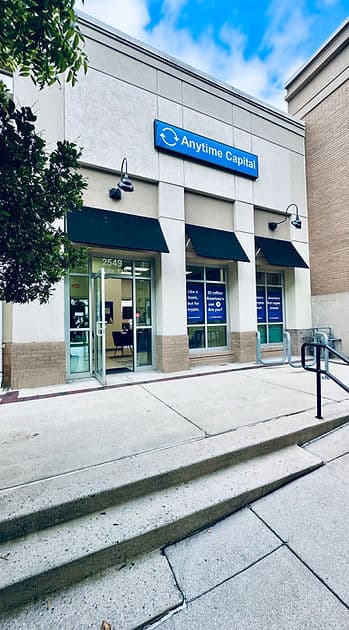

Anytime Capital runs its own branches in Atlanta and Miami. Partner stores run the same counter service.
The pitch a store owner usually hears is machine-shaped: let us put a Bitcoin ATM in the corner, we will split the fees. It works for some sites. But it asks the store to give up floor space, run power to a box it does not own, and accept whatever the machine's daily limits and pricing do to the customer experience — while the store's own staff have no involvement in the transaction and no ability to help when something goes wrong.
A counter service inverts all of that. The service lives on a screen your employee is already holding. There is nothing to fit, nothing to insure and nothing to explain to a landlord. Larger orders are a conversation with a human rather than a hard cap enforced by a note acceptor. And because your staff run the transaction, the customer's relationship stays with your store.
It also means the revenue is not bounded by one machine in one corner. Every employee on shift can serve a crypto customer at the same time, from any position on the counter, including the drive-up window if you have one.
You are responsible for the things a store is good at: serving the customer, collecting the payment, keeping your own books, and following the training your staff are given. That is the whole list.
You are not the money services business. Anytime Capital is the registered MSB — FinCEN registration number 31000321862986 — and carries the customer identification programme, the transaction monitoring, the recordkeeping and the regulatory reporting that go with the activity. You do not hold customer crypto, you do not custody private keys, and you are not asked to obtain a money transmitter licence of your own to act as a location for ours.
If your store already holds a check casher or money transmitter licence in your state, that does not go away and nothing here replaces it. It usually makes the conversation shorter, because your business is already known to a regulator and already runs the kind of recordkeeping this activity expects.
The cluster
Written for the questions in the order they actually get asked, not in the order a brochure would put them.
The store is a serving location, not a counterparty. Your employee places the order through Anytime Capital's retail platform on behalf of the customer standing in front of them. Anytime Capital sources and delivers the crypto to the customer's wallet. The store collects the payment and earns a share of the transaction. At no point does the store hold cryptocurrency or control a private key.
Not one of your own to act as a location for Anytime Capital. Anytime Capital is the registered money services business (FinCEN registration number 31000321862986) and carries the compliance programme for the activity. State law varies and your own circumstances matter, so we confirm what applies to your specific store during onboarding, and nothing here is legal advice. See the compliance page for the full explanation.
Nothing, because there is no equipment. The platform runs in a browser at https://retail.anytime-capital.com on a phone, tablet or the PC already behind your counter. There is no kiosk to buy or lease, no cash recycler to load, and no monthly platform fee to earn back.
A returning customer who is already verified takes under a minute. A brand new customer takes one to two minutes, because their identity has to be captured and checked once. After that first visit they are on file and every subsequent order is fast.
It depends on your foot traffic and on the revenue share in your agent agreement. Because crypto is priced as a percentage of the order rather than as a flat fee, a single $500 order is typically worth more to a store than a large number of money orders. The earnings page works the arithmetic through at several order sizes so you can run your own numbers.
Yours. Per-store branding is rolling out: your sign-in page will carry your store's logo and your store's colours, so your customer sees the shop they already know rather than a company they have never heard of. Send us your logo during onboarding.
More than 38 assets, including Bitcoin, Ethereum, Solana, XRP and Litecoin, plus the stablecoins USDT and USDC across several networks. Stablecoins matter more than people expect in stores that serve remittance customers.
Sell orders are supported on the platform. Whether your particular location handles cash-out, and at what size, is set during onboarding based on your store's cash position and the applicable rules — this is exactly the kind of thing the retail team walks through with you rather than something to guess at from a web page.
Anytime Capital's retail counter is live in the United States. International locations are being onboarded market by market as licensing allows, and the global section of this site covers what the model looks like for currency exchanges, remittance agents and mobile money agents in each region.
Tell us where your store is and what your customers keep asking for. We will tell you what we can offer at your location.