Everything you sell is already intangible
No stock, no display, no shrink. Your counter is built for products that exist only as a transaction.
A wireless store's counter is a stack of small-margin digital products sold to a cash-paying, internationally connected customer base. Crypto is the same kind of product with far more revenue in it.
$200.00
USDT · bought alongside an international top-up
Almost everything a wireless store sells at the counter is already digital: airtime, data bundles, international top-ups, device protection. Your staff are used to selling a product that has no box and no shelf, and your customers are used to buying one.
There is also an unusually direct overlap between international top-up customers and stablecoin demand. A person buying minutes for a family member abroad is, by definition, part of a cross-border household — the exact profile that has been discovering that dollar-denominated stablecoins move faster than the alternatives.
And the practical obstacle that stops most people buying crypto — not having a wallet, not knowing how — dissolves in a phone store, because the customer's device is in their hand and your staff set devices up for a living.
Why it fits
Every store type in this program runs the same platform. What changes is the customer, the ticket size and the objection — so this is the part written for you rather than for everybody.
No stock, no display, no shrink. Your counter is built for products that exist only as a transaction.
International airtime is the clearest available signal that a customer has a cross-border household, and those households are the ones asking about stablecoins.
A customer with no wallet is a two-minute problem in a phone store and a dead end almost anywhere else.
A percentage of a few hundred dollars against the margin on a top-up is not a close comparison.
Getting started
Where the store is, what it already offers, and what your foot traffic looks like. We tell you straight away whether we can serve your market.
Entity documents, ownership and any licences your store already holds. Days, not months.
One session per employee. No crypto knowledge required — the order screen is shorter than a money order form.
Logins switched on, revenue share accruing on every order your staff place.
The arithmetic
You keep a share of every order. Bigger order, bigger share. The examples below use 1% to 3% — your own rate is in your agreement.
| At the counter | Order size | Store keeps (low) | Store keeps (high) |
|---|---|---|---|
| A customer cashes a check and puts part of it into Bitcoin | $200 | $2.00 | $6.00 |
| A regular buys USDT to send to family overseas | $500 | $5.00 | $15.00 |
| A customer sells crypto and takes the cash | $1,000 | $10.00 | $30.00 |
| A small business owner buys on payday, every other week | $2,500 | $25.00 | $75.00 |
| One larger order, the kind an ATM's daily cap refuses | $10,000 | $100.00 | $300.00 |
The figures above are worked examples, not projected or guaranteed earnings. They show how the arithmetic works on a given order size at an illustrative revenue-share range. Your actual rate is set in your agent agreement, and what any individual store earns depends on its foot traffic, its neighbourhood, its hours and how many customers it serves. Anytime Capital does not promise any level of income.
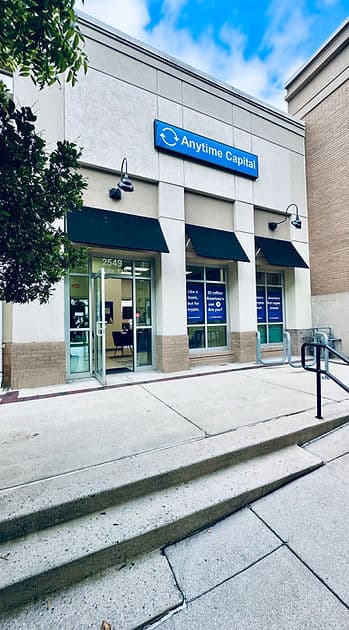

Anytime Capital runs its own branches in Atlanta and Miami. Partner stores run the same counter service.
The single biggest drop-off point in retail crypto is a customer who wants to buy but has nowhere to receive the asset. In most store types that is friction. In a phone store it is your core competence — your staff install and configure applications on customer devices every day.
Customers who do not already have a wallet can be set up with a free non-custodial Anytime Capital wallet, which means they hold their own keys rather than depending on an account they might lose access to.
Doing that well is also a retention play. A customer whose wallet your store set up comes back to your store when they want to buy again.
Wireless store traffic splits between quick transactions — a top-up, a bill payment — and long ones, where a customer is buying or activating a device. The long ones are where a first-time crypto verification fits perfectly, because the customer is already sitting there with their ID out.
The quick ones are where returning customers come in, and those orders take under a minute once the customer is on file.
In practice that means the product costs your store almost no incremental time after the first month, which is when most of the verifications happen.
Keep reading
The numbers, the rules and the alternative you have probably been offered.
Customers who do not already have a wallet can be set up with a free non-custodial Anytime Capital wallet. They hold their own keys — your store never controls them.
It is a separate service on the same counter. Read your own carrier and dealer agreements for exclusivity language, as some contain restrictions on what else may be sold.
Crypto orders tend to be considerably larger than a top-up even from the same customer, and the revenue is a percentage of the order rather than a flat margin.
No. They need to know how to start a verification, read a quote to a customer and take a payment. The training is one session.
Not to act as a serving location for Anytime Capital's platform. Anytime Capital is the registered money services business and carries the compliance programme for the activity. What applies to your specific store and state is confirmed during onboarding, and nothing here is legal advice.
A share of each order, set in your agent agreement. Because crypto is priced as a percentage of the order rather than a flat fee, the revenue moves with the ticket. The earnings page works the arithmetic through at five order sizes.
Tell us where the store is and what your customers keep asking for. We will tell you what we can offer at your location.