Answer
What is SPEI?
Quick answer
SPEI (Sistema de Pagos Electrónicos Interbancarios) is Banco de México's system for real-time peso transfers between banks, operating since 2004 and now open 24/7. Payments are addressed by the recipient's 18-digit CLABE, usually arrive in seconds, and can be proven with a CEP, an electronic receipt issued through Banco de México.
Updated October 2026. Evergreen page — refreshed in place as facts change.
- Launched
- 2004
- Built and operated by Banco de México
- Operator
- Banxico
- Settles across accounts at the central bank
- Speed
- Seconds
- Typical; banks' own checks can add time
- Hours
- 24/7/365
- Weekends and holidays included
- Network limit
- No cap
- Banks set per-payment and daily limits
- Identifier
- CLABE
- 18 digits; debit card numbers also work
- Volume
- 7.3B
- Transfers in 2025 (Banco de México)
- Who can use it
- Peso accounts
- At banks and fintechs that join SPEI
SPEI is the plumbing behind almost every bank transfer in Mexico. Banco de México's Sistema de Pagos Electrónicos Interbancarios has run since 2004 and carried about 7.3 billion transfers in 2025, worth roughly 17 times Mexico's GDP (Banco de México). A SPEI transfer moves pesos between accounts at participating institutions in seconds, at any hour, addressed by an 18-digit CLABE, and leaves behind a receipt anyone can verify: the CEP. Here is what SPEI is, how a transfer moves, the limits and fees, how to prove and protect a payment, and how a US business pays a Mexican supplier in pesos.
Payment methods on this page
 SPEIMexico · seconds
 PIXBrazil · seconds
- SWIFT1–5 business days
- RTPSeconds · 24/7
.svg) USDCMinutes · 24/7
What is SPEI and who can use it?
SPEI is Mexico's real-time interbank payment system, designed and operated by Banco de México (Banxico). Banks are its core participants, joined by brokerages, savings institutions and, increasingly, regulated fintech payment institutions, so a transfer can go from a traditional bank to a digital account as easily as between two banks. Each transfer settles individually across the participants' accounts at Banxico, which makes a credited SPEI payment final.
It moves only pesos. Dollar transfers between accounts in Mexico use a separate Banxico system, SPID, with its own restrictions, and payments from abroad arrive by SWIFT. Within pesos, SPEI handles everything from a few pesos between friends to payroll and large supplier payments: 7,308 million transfers worth about MXN 592 trillion in 2025, according to Banxico's annual report on financial market infrastructures.
Two consumer services run on top of it. CoDi, launched in 2019, lets businesses collect payments by QR code; DiMo (Dinero Móvil), introduced in 2023, lets people send money to a mobile number linked to an account. Both are SPEI transfers underneath.
How does a SPEI transfer move?
The payer's institution checks the CLABE's control digit, debits the payer and submits the transfer to SPEI, which settles it at Banxico and passes it to the receiving institution. That institution credits the account and confirms, or returns the payment if the account cannot receive it. Each transfer carries a tracking key, the clave de rastreo, assigned by the sending institution — the reference both sides, and Banxico's receipt service, use to find it later.
A SPEI transfer, start to finish
- 1
Payer enters
CLABE, beneficiary name, amount, a payment concept and an optional numeric reference.
Any hour - 2
Bank submits
Checks the control digit, debits the payer and sends it with a tracking key.
Clave de rastreo - 3
Banxico settles
SPEI moves the funds between the two institutions' accounts at the central bank.
Seconds - 4
Receiver credits
The receiving institution posts it, or returns it if the account can't take it.
Seconds - 5
CEP issued
Banxico's site produces the electronic proof of payment from the transfer's details.
CEP
How long does a SPEI transfer take, and does it work on weekends?
Typically seconds, at any hour of any day: SPEI runs 24 hours a day, 365 days a year. When a transfer takes longer, the delay is almost always at one of the institutions — a sending bank's fraud or limit check, or a receiving institution that is slow to credit — rather than in SPEI itself. Some banks also apply tighter limits or extra checks to large transfers sent outside business hours.
For a business paying from the US, that removes the weekend gap that wires leave. A SPEI payment to a supplier in Monterrey released on a Saturday evening is credited on Saturday evening, while a wire sent at the same moment waits for Monday at both banks.
When money reaches Mexico, across a week
SPEI
Pesos, in Mexico
SWIFT wire
US to Mexico
Fedwire
US wires
FedNow & RTP
US instant
What are SPEI's limits and fees?
Banxico sets no maximum amount for a SPEI transfer, which is why the same system carries both small payments and large corporate ones. The limits a customer actually meets are their own institution's: per-transfer and daily caps by account type and channel, which business accounts can usually raise by agreement with the bank.
Most Mexican banks don't charge individuals for SPEI transfers made in online or mobile banking; business-account tariffs vary, and transfers made at a branch can carry a fee. Receiving a SPEI transfer is generally free, and the CEP costs nothing for either side.
| What | Rule | Set by |
|---|---|---|
| Network maximum | None | Banco de México |
| Per-transfer and daily limits | By account type and channel; negotiable for businesses | Each institution |
| Cost to individuals, online | Usually free | Bank tariffs |
| Cost to businesses | Varies by bank and plan | Bank tariffs |
| Hours | 24/7/365 | Banco de México |
| Currency | Pesos only; dollars between Mexican accounts use SPID | Banco de México |
| Proof of payment | CEP, free, from Banxico's website | Banco de México |
What do you need to send a SPEI payment?
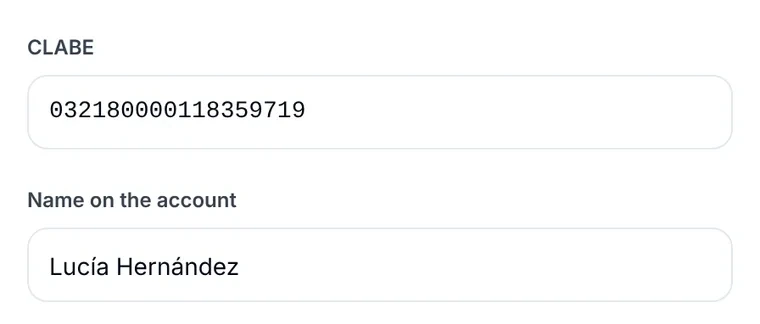
The recipient's CLABE (Clave Bancaria Estandarizada) and name. A CLABE has 18 digits: three for the bank, three for the city (plaza), eleven for the account and a final control digit computed from the other seventeen, so most typing errors fail before anything is sent. It is not the account number printed on a card; Mexican banks show the CLABE separately in their apps and on statements. Transfers can also be addressed to a debit card number, but a CLABE is the standard for business payments.
Two optional fields help the payee reconcile: a payment concept of up to 40 characters, where the invoice number belongs, and a numeric reference of up to seven digits. For a company, use the legal name (razón social) exactly as the bank holds it.
How do you prove a SPEI payment, and how do you avoid SPEI fraud?
The CEP (Comprobante Electrónico de Pago) is the proof. Banxico issues it through its website once the receiving institution has credited a transfer: enter the date, the tracking key or numeric reference, the two institutions, the CLABE and the amount, and it returns a document with the payer's and payee's details and the exact time of settlement. A screenshot from a banking app is not proof of payment; a CEP is.
That distinction is where most SPEI fraud lives. Fake transfer screenshots are a common scam against sellers, and invoice-redirection scams send a buyer a new CLABE that belongs to someone else. The receiving institution credits by CLABE, so a mismatched name is not a reliable safety net, and once credited a transfer only comes back with the recipient institution's cooperation. The habits that prevent both:
- Confirm a payment by its CEP, or in your own account, before releasing goods — never by a screenshot.
- Verify any new or changed CLABE by phone, on a number you already had.
- Check the first three digits: they identify the bank, so a CLABE that doesn't match the supplier's bank is a warning sign.
- Keep the tracking key of every transfer you send; it is how your bank and Banxico find it.
SPEI vs SWIFT, RTP and FedNow
SPEI is Mexico's equivalent of RTP and FedNow, and more than a decade older than either: a 24/7, real-time, final rail run by the central bank. The difference for cross-border payers is that SPEI can only be reached from inside Mexico. A SWIFT wire from the US arrives on business days through correspondent banks, and the Mexican bank converts dollars at its own rate unless the supplier holds a dollar account.
| Rail | Speed | Hours | Addressed by | Max per payment | Proof |
|---|---|---|---|---|---|
| SPEI | Seconds | 24/7/365 | 18-digit CLABE | No network cap | CEP from Banxico |
| SWIFT wire to Mexico | 1–3 business days | Bank business days | CLABE or account + SWIFT code | Bank limits | Bank confirmation with UETR |
| RTP (US) | Seconds | 24/7/365 | Routing + account number | $10 million | Bank confirmation |
| FedNow (US) | Seconds | 24/7/365 | Routing + account number | $10 million (bank default $100,000) | Bank confirmation |
| Fedwire (US) | Same business day | Business days | Routing + account number | No network cap | IMAD / OMAD |
How does a US business pay a supplier in Mexico by SPEI?
A US bank can't send SPEI; only institutions in Mexico can. From a US account the default is an international wire, and the question becomes which currency it lands in. Sent in dollars to a peso account, the Mexican bank converts at its own rate; sent to a dollar account, the supplier keeps dollars, though dollar accounts in Mexico are restricted largely to companies and residents of border areas. Either way, expect one to three business days and fees on both sides.
Paying in pesos over SPEI through a provider with Mexican accounts is quicker for the supplier and simpler to reconcile: the invoice amount in pesos arrives as a domestic transfer, with a CEP to prove it. Before switching a supplier to it, agree:
- That the invoice is priced in pesos, so the amount that arrives is the amount owed.
- The CLABE, the legal name and, ideally, the RFC (tax ID) shown on the invoice.
- Where your invoice number goes: the 40-character payment concept.
- How the supplier will confirm receipt: by CEP, or from their own statement.
How does SPEI work on Anytime Capital?
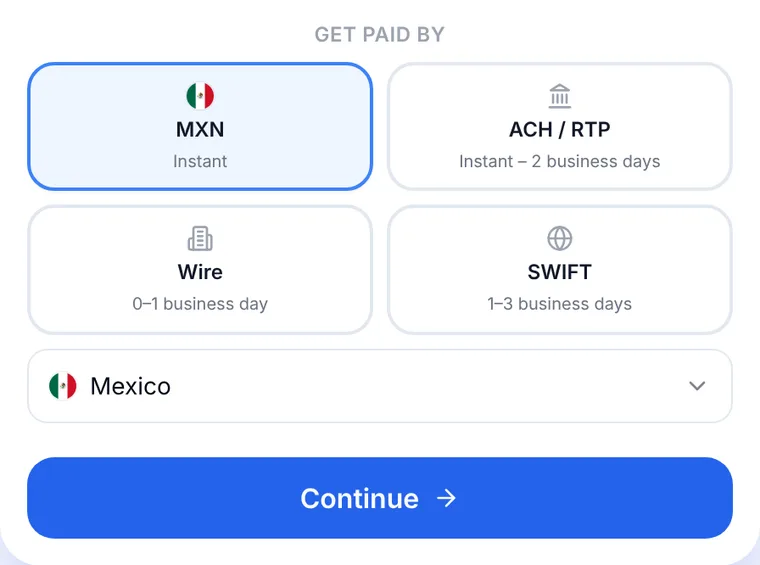
Anytime Capital business accounts pay Mexican suppliers in pesos over SPEI, from the same balance that holds your US receipts. Adding a Mexican recipient takes the 18-digit CLABE and the name — the person's, or the business's legal name — which is all SPEI needs to find the account. Mexico is one of the 71 countries we pay out to over local rails, with SWIFT for everywhere else.
At the review step you see the peso amount that will arrive, the rate behind it and the fee on its own line before anything leaves your balance, and the expected arrival for SPEI reads usually within minutes. A quoted price is held for a short countdown on screen, so the peso figure you approve is the one we send. Every payout keeps its rate, rail and reference in your records for reconciliation, and processing is subject to compliance review.
On Anytime Capital
FedNow, RTP, Fedwire and ACH in one business account
Pick the rail per payment instead of per bank: instant when it has to land now, a wire when the counterparty insists, ACH when it can wait, and local rails or stablecoins when it crosses a border. Sign up online in minutes.
- RTP & FedNowSeconds, any day
- WireSame day
- ACH to vendorsSame day or next day
- 71+ countriesMinutes to same day
- USDC & USDTMinutes, including weekends
Business account
Send and receive on every US rail
US account and routing numbers in your business's own name. Get paid by FedNow, RTP, wire or ACH, and pay the same ways, with every movement in one ledger.
Enterprise treasury
Operating accounts, approvals, API
Operating accounts and sub-accounts, approval rules and an audit trail, plus an API and signed webhooks for moving money from your own systems.
Personal
A cash account with a debit card
A cash account and card with early direct deposit and crypto built in, opened online in minutes, with no minimum balance.
Frequently Asked Questions
What is a CLABE number?
Mexico's standard 18-digit interbank account number: three digits for the bank, three for the city, eleven for the account and one control digit. It is what SPEI uses to route a transfer, and it differs from the account or card number a bank prints elsewhere.
How long does a SPEI transfer take?
Usually seconds. SPEI settles in real time at Banco de México; longer delays come from the sending or receiving institution's own checks, not from SPEI.
Does SPEI work on weekends and holidays?
Yes. SPEI runs 24 hours a day, 365 days a year. Some banks apply their own limits or extra checks to large transfers outside business hours.
What is a CEP and how do I get one?
The Comprobante Electrónico de Pago is the official proof that a SPEI transfer was credited. Either side can download it free from Banco de México's website by entering the date, tracking key or reference, both institutions, the CLABE and the amount.
Can I send a SPEI transfer from the US?
Not from a US bank, which can only send an international wire. A provider with accounts in Mexico can convert dollars and send SPEI domestically, so the supplier receives pesos within moments of the payout being released.
Is there a limit on SPEI transfers?
Banco de México sets no maximum. Each bank sets per-transfer and daily limits by account type and channel, and business accounts can usually raise them by agreement.
Can a SPEI transfer be reversed?
Not by the payer once it is credited; it is final. A transfer to an invalid or closed CLABE is returned automatically. Money sent to the wrong valid account comes back only if the receiving institution and its customer cooperate.
What is the difference between SPEI, CoDi and DiMo?
SPEI is the interbank system; CoDi (2019) and DiMo (2023) are Banco de México services built on it. CoDi lets businesses collect by QR code, and DiMo lets people send money to a mobile number linked to an account. Both settle as SPEI transfers.
Keep reading
Important Disclosures
- Network limits, hours, volumes and dates cited on this page come from each network operator's published rules and statistics as of the dates shown, and may have changed. Banks and payment providers set their own limits and cutoffs within the network maximums.
- Payment network names (Fedwire, FedNow, RTP, ACH, SEPA, Faster Payments, PIX, SPEI, UPI, PayNow and others) belong to their operators and are used to identify the networks only; no affiliation or endorsement is implied.
- Information on this page is general and educational — it is not financial, legal, or tax advice.
- Anytime Capital is a fintech company, not a bank. Banking services are provided by our licensed banking partners. Stablecoins and other digital assets are not bank deposits, are not FDIC-insured and may lose value.