Answer
What is a Pix payment?
Quick answer
Pix is Brazil's instant payment system, created and run by the Banco Central do Brasil since November 2020. It moves reais between accounts in seconds, 24/7, addressed by a Pix key — a CPF or CNPJ tax number, phone, email or random key — or a QR code, and is free for individuals.
Updated October 2026. Evergreen page — refreshed in place as facts change.
- Launched
- Nov 2020
- November 16, 2020
- Operator
- Banco Central
- Runs the SPI settlement and DICT directory
- Speed
- Seconds
- Settled in central bank money
- Hours
- 24/7/365
- Lower night limits for individuals by default
- Limit
- Bank-set
- No network cap; institutions set limits
- Identifier
- Pix key
- CPF/CNPJ, phone, email, random key or QR
- Volume
- ~80B
- Transactions in 2025, R$35.3T (BCB)
- Who uses it
- 148M people
- 86% of adults, plus 12.8M firms (2025)
Pix is how Brazil pays. Built and run by the Banco Central do Brasil and launched on November 16, 2020, the Pix payment system carried about 80 billion transactions worth R$35.3 trillion in 2025, and 148 million people — 86% of Brazilian adults — used it (Banco Central do Brasil). A Pix payment moves reais between accounts in seconds, at any hour, addressed by a Pix key or a QR code rather than a bank, branch and account number. This page explains what a Pix payment is, how it moves, its limits and costs, how the MED refund mechanism works, and how a US business can pay a Brazilian supplier by Pix.
Payment methods on this page


.svg)
What is a Pix payment, and why does Brazil use it for almost everything?
A Pix payment is an instant credit transfer in reais between two accounts at Brazilian institutions: traditional banks, digital banks and payment institutions alike, with the largest required to offer it. The Banco Central do Brasil (BCB) wrote the rules and also runs the infrastructure — the SPI (Sistema de Pagamentos Instantâneos), which settles each payment in central bank money, and the DICT, the directory that turns a Pix key into an account.
Pix replaced slower and pricier options. Before it, a transfer between banks meant a TED, which ran only during business-day hours and usually carried a fee, or a DOC, which took until the next business day and was retired in 2024; bills were paid by boleto, which takes days to clear. Pix made transfers free for individuals and available at any hour, and by 2025 people paying businesses made up 43% of Pix transactions (BCB).
Use kept climbing: 79.8 billion transactions in 2025, up 25.7% on 2024, and a single-day record of about 290 million in September 2025. For scale, the US FedNow Service handled about 8.4 million payments in all of 2025. Pix keeps adding features, too: Pix Automático, launched in June 2025, lets a customer authorise recurring charges once, the way a direct debit works.
How does a Pix payment move?
A Pix payment starts with a lookup, not an account number. When the payer enters a key or scans a QR code, their institution queries the DICT, which returns the account the key belongs to and the holder's name, with part of their CPF or CNPJ masked, so the payer can see who they are about to pay. Once the payer confirms, the SPI settles the payment between the two institutions' accounts at the central bank and the receiving institution credits it — all within seconds.
A Pix payment, start to finish
- 1
Payer enters
A Pix key, a QR code or a 'Pix Copia e Cola' code, and the amount.
Any hour - 2
DICT looks up
The directory returns the account, the holder's name and a partly masked CPF or CNPJ.
Before confirming - 3
Payer confirms
Authorised in the bank app, within the payer's daytime or night limit.
Seconds - 4
SPI settles
Central bank money moves between the two institutions' accounts at the BCB.
Real time - 5
Receiver is credited
Funds are usable at once; both sides get a receipt with the E2E ID.
E2E ID
How fast is Pix, and does it work at night and on weekends?
Pix runs 24 hours a day, 365 days a year, and most payments settle in seconds. What changes at night is how much an individual can send: by default, institutions apply a lower limit to personal accounts between 8 p.m. and 6 a.m., a rule the central bank introduced after a rise in express kidnappings. Customers can change their limits in their app, but an increase takes effect only after a waiting period, so a thief cannot raise it on the spot.
The night-time default applies to individuals sending money. Receiving is unaffected, so a supplier in São Paulo paid at 3 a.m. local time sees the money at 3 a.m. Compare the alternatives a Brazilian payee would otherwise wait on:
Typical time for reais to arrive
- PixSeconds
- TEDMinutes, business hours
- Boleto1–3 business days
- SWIFT wire to Brazil1–3 business days
What are the Pix limits and fees?
Pix has no network-wide maximum per payment. Each institution sets limits by account and channel, customers can lower theirs at any time in the app, and individuals have the separate night-time limit. For companies, limits are usually agreed with the institution and can be far higher.
Individuals don't pay to send or receive Pix: the central bank's rules make it free for people, with exceptions such as an individual receiving payments for sales. Companies (CNPJ accounts) can be charged by their institution, typically to receive payments, and prices vary. In 2025, 12.8 million businesses used Pix (BCB).
| What | Rule | Source |
|---|---|---|
| Network maximum | None; each institution sets limits | Banco Central do Brasil |
| Night limit, individuals | Lower by default, 8 p.m.–6 a.m. | BCB rules |
| Raising a limit | Takes effect after a waiting period, not at once | BCB rules |
| Fees, individuals | Free to send and receive, with exceptions for commercial receipts | BCB rules |
| Fees, companies | Set by each institution, typically for receiving | Institution tariffs, 2026 |
| Keys per account | Up to 5 for individuals, 20 for companies | DICT rules |
| Fraud refund request (MED) | Up to 80 days after the payment | BCB MED rules |
What do you need to send or receive a Pix payment?
A Pix key, or a QR code that contains one. There are five kinds of key: a CPF (the 11-digit individual taxpayer number), a CNPJ (the 14-character company registration number), a mobile phone number, an email address, or a random key — a long code the institution generates for people who would rather not share personal data. Each key points to exactly one account; an individual can register up to five keys per account and a company up to twenty, and about 920 million keys were registered in 2025.
QR codes come in two kinds: static codes, printed at a till for any amount, and dynamic codes generated per sale with the amount and an expiry built in. Both can be shared as a 'Pix Copia e Cola' text string for paying on the same phone without scanning.
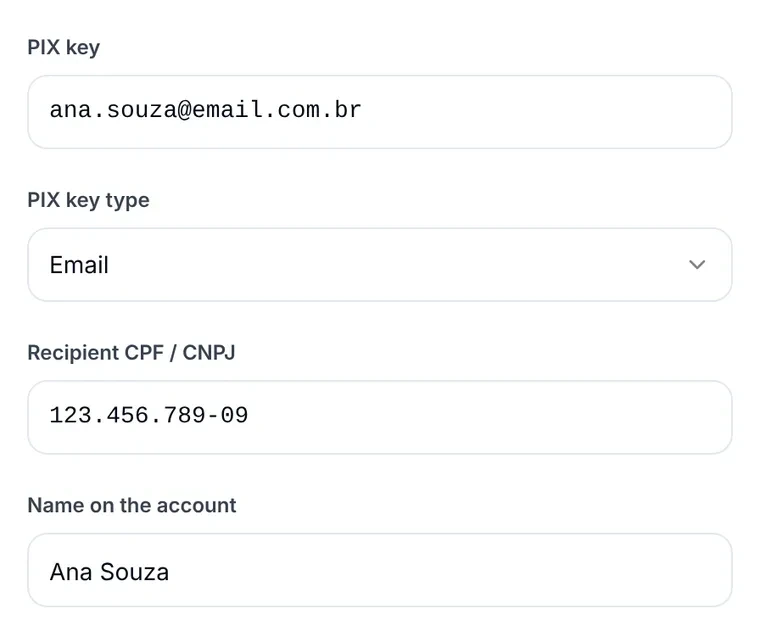
Paying from abroad needs one more detail: the recipient's CPF or CNPJ. Money entering Brazil from another country is a foreign-exchange operation that an authorised institution has to carry out and report, identifying who receives it, so a cross-border Pix payout asks for the tax number even when the key itself is an email or a phone number.
How does Pix protect against fraud, and can a Pix be reversed?
A Pix payment is final: the payer cannot cancel it once sent. Protection comes in three layers. Before the payment, the DICT lookup shows the payer whose account a key belongs to. Around it, a receiving institution can hold incoming funds for up to 72 hours when it suspects fraud (the 'bloqueio cautelar') and must tell the recipient when it does. After it, the Special Return Mechanism — MED, in place since late 2021 — lets a victim of fraud, or of an institution's operational failure, ask for the money back within 80 days.
The original MED could only recover money still sitting in the first account that received it, and fraudsters learned to move it on within seconds. MED 2.0, mandatory for institutions since February 2026, traces funds through the accounts they were moved to and blocks them there as well. Recovery still depends on money being left to return, which is why the advice is to report a fraudulent Pix to your institution immediately. For a business receiving Pix:
- Register your CNPJ as a Pix key, so payers looking you up see your company's name rather than an employee's.
- Publish your keys in one place, and tell customers you never change them by message.
- Release goods against the credit in your own account, not a receipt a customer shows you; receipts are easy to fake.
- Report a suspected fraud to your institution the same day, while MED can still find the money.
Pix vs SWIFT, TED and FedNow
Pix belongs to the same family as FedNow and RTP in the US — an instant, final, credit-push rail that runs around the clock — but adoption followed a different path. Brazil's central bank required large institutions to offer Pix and made it free for individuals, and within five years it was the country's most used payment method. In the US, joining FedNow or RTP is each bank's choice: FedNow carried about 8.4 million payments in 2025 and RTP 343 million in 2024, against Pix's 80 billion in 2025.
| Rail | Speed | Hours | Addressed by | Typical cost |
|---|---|---|---|---|
| Pix | Seconds | 24/7/365 | Pix key or QR code | Free for individuals; companies per tariff |
| TED | Minutes to hours | Business-day hours | Bank, branch, account + CPF/CNPJ | Bank fee, often charged |
| Boleto | 1–3 business days to clear | Business days | Barcode on the bill | Fee to the issuing business |
| SWIFT wire to Brazil | 1–3 business days | Bank business days | Bank details + CPF/CNPJ | Sending and intermediary fees, plus exchange spread |
| FedNow / RTP (US) | Seconds | 24/7/365 | Routing + account number | Set by each bank |
How does a US business pay a supplier in Brazil by Pix?
Pix only connects accounts at Brazilian institutions, and every payment into Brazil from abroad has to pass through a foreign-exchange operation first. From an ordinary US bank, that means an international wire: dollars sent over SWIFT to the supplier's bank, which converts them into reais under an exchange contract, often charging a fee and taking one to three business days.
A provider with a presence in Brazil can do the exchange and pay the supplier by Pix instead, so the reais arrive in seconds once the payment is released and the supplier sees an ordinary Pix credit. What to ask your supplier for, and what to settle first:
- A Pix key and its type — for a company, ideally its CNPJ key, which identifies the business rather than a person.
- The CPF or CNPJ of the account holder, which a payment from abroad has to carry.
- The legal name on the account, to compare with the name on the invoice.
- Who bears the exchange cost: price the invoice in reais if the supplier must receive an exact amount.
How does Pix work on Anytime Capital?
Anytime Capital business accounts pay Brazilian suppliers, studios and contractors in reais over Pix, drawing on the same balance as your US payments and the other local rails we pay out on in 71 countries. A Brazilian recipient is added with a Pix key, its type — CPF, CNPJ, email, phone or random — and the recipient's CPF or CNPJ, which a payment into Brazil has to carry.
When you send, the review shows what the supplier receives in reais at the rate you are quoted, with the fee listed separately, Pix named as the rail and usually within minutes as the expected arrival; the Pix itself settles in seconds once the payout is released, and processing is subject to compliance review. Check the key against the supplier's invoice before you add it: a Pix payment cannot be recalled once it settles.
On Anytime Capital
FedNow, RTP, Fedwire and ACH in one business account
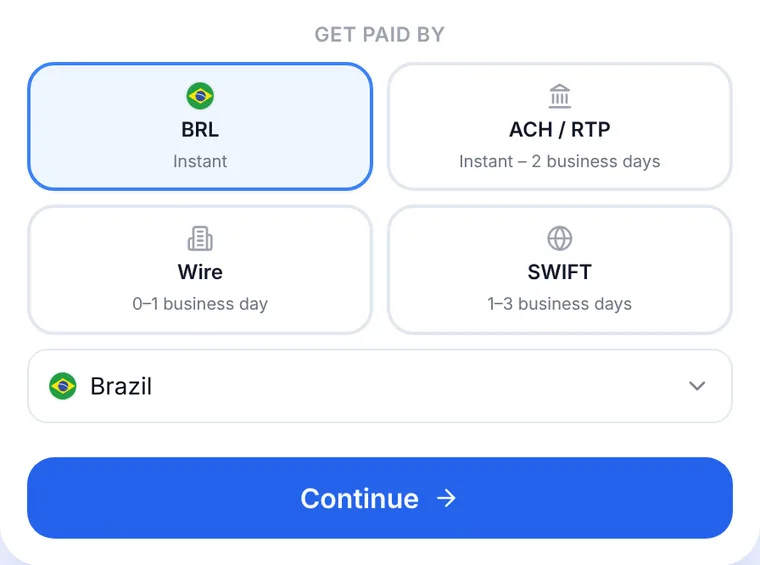
Pick the rail per payment instead of per bank: instant when it has to land now, a wire when the counterparty insists, ACH when it can wait, and local rails or stablecoins when it crosses a border. Sign up online in minutes.
- RTP & FedNowSeconds, any day
- WireSame day
- ACH to vendorsSame day or next day
- 71+ countriesMinutes to same day
- USDC & USDTMinutes, including weekends
Business account
Send and receive on every US rail
US account and routing numbers in your business's own name. Get paid by FedNow, RTP, wire or ACH, and pay the same ways, with every movement in one ledger.
Enterprise treasury
Operating accounts, approvals, API
Operating accounts and sub-accounts, approval rules and an audit trail, plus an API and signed webhooks for moving money from your own systems.
Personal
A cash account with a debit card
A cash account and card with early direct deposit and crypto built in, opened online in minutes, with no minimum balance.
Frequently Asked Questions
Is Pix free?
For individuals, yes: the Banco Central do Brasil's rules make sending and receiving Pix free for people, with exceptions such as receiving payments for sales. Companies can be charged by their institution, usually to receive.
Can a Pix payment be reversed or cancelled?
Not by the payer once it is sent: Pix is final. If the payment was a fraud, the victim's institution can open a MED request within 80 days, and since February 2026 MED 2.0 can trace and block the money in the accounts it was moved to. Recovery depends on funds still being there.
Can you use Pix outside Brazil?
Pix only moves reais between accounts at Brazilian institutions. Someone abroad can still pay a Pix recipient through a provider that converts their currency and sends the Pix inside Brazil, using the recipient's key and CPF or CNPJ.
What is a Pix key?
An alias for a Brazilian account: a CPF or CNPJ, a phone number, an email address or a random key. It is registered in the central bank's DICT directory, points to one account, and lets a payer send money without knowing the bank, branch or account number.
Is there a limit on Pix transfers?
There is no network-wide maximum. Each institution sets limits, customers can lower theirs at any time, individuals have a lower default limit between 8 p.m. and 6 a.m., and raising a limit takes effect only after a waiting period.
Does Pix work at night and on weekends?
Yes. Pix runs 24 hours a day, every day, including holidays. Only the amount an individual can send changes at night, under the default 8 p.m.–6 a.m. limit; receiving is unaffected.
What is Pix Automático?
A Pix feature launched in June 2025 for recurring payments. The customer authorises a company once, in their bank app, and later charges are paid by Pix automatically within the terms they approved, much like a direct debit.
Keep reading
Important Disclosures
- Network limits, hours, volumes and dates cited on this page come from each network operator's published rules and statistics as of the dates shown, and may have changed. Banks and payment providers set their own limits and cutoffs within the network maximums.
- Payment network names (Fedwire, FedNow, RTP, ACH, SEPA, Faster Payments, PIX, SPEI, UPI, PayNow and others) belong to their operators and are used to identify the networks only; no affiliation or endorsement is implied.
- Information on this page is general and educational — it is not financial, legal, or tax advice.
- Anytime Capital is a fintech company, not a bank. Banking services are provided by our licensed banking partners. Stablecoins and other digital assets are not bank deposits, are not FDIC-insured and may lose value.