Answer
What is an RTP payment? The Real-Time Payments network explained
Quick answer
An RTP payment is an instant bank-to-bank transfer on the RTP network, operated by The Clearing House since November 2017. Payments settle in seconds, 24/7/365, are final once sent, and can be up to $10 million each. The recipient's bank confirms receipt immediately, and the money is available right away.
Updated October 2026. Evergreen page — refreshed in place as facts change.
- Operator
- TCH
- The Clearing House, bank-owned
- Launched
- Nov 2017
- First new US core rail in decades
- Hours
- 24/7/365
- Weekends and holidays included
- Limit
- $10M
- Per payment, since Feb 9, 2025
- 2024 value
- $246B
- 343 million payments
- 2025 value
- $1.3T+
- January through November
- Record day
- 1.81M
- Payments on Oct 3, 2025
- Direction
- Push only
- Plus request for payment
RTP — short for Real-Time Payments — is the instant payment network most large US banks have run on since 2017, years before FedNow. If your payroll provider pays you instantly, an insurer pays a claim on a Sunday, or a supplier is paid the minute an invoice is approved, there is a good chance it moved on RTP. This page explains what an RTP payment is, how it settles, its limits and costs, request for payment, how it compares with ACH and wires, and how businesses use it.
Payment methods on this page
What is the RTP network?
The RTP network is an instant payment system operated by The Clearing House (TCH), a company owned by many of the largest US banks that also runs CHIPS and an ACH operator. Launched in November 2017, it was the first new core payment infrastructure in the US in more than four decades. Banks and credit unions connect to it directly or through processors, and their customers send and receive RTP payments through ordinary online banking, treasury platforms and payment apps.
Growth accelerated sharply once the limit rose: RTP processed $246 billion in 2024 across 343 million payments, then more than $1.3 trillion in 2025 through November — a more than fivefold increase driven by business payments after the $10 million limit took effect in February 2025. The Clearing House reported a single-day record of 1.81 million payments worth $5.2 billion on October 3, 2025.
How does an RTP payment work?
RTP settles differently from FedNow. Participating banks prefund a joint account held at the Federal Reserve Bank of New York, and each RTP payment moves value between the banks' positions in that account instantly; banks top up their positions with Fedwire transfers as needed. The messages themselves are ISO 20022, carrying rich remittance detail with every payment.
Inside an RTP payment
- 1
Send
The payer's bank sends a credit transfer with remittance data.
ISO 20022 - 2
Validate
RTP checks the message and the sending bank's position.
Milliseconds - 3
Accept
The receiving bank accepts the payment for its customer.
Seconds - 4
Settle
Positions move in the joint account at the New York Fed.
Instant - 5
Confirm
Both banks are notified; funds are available and final.
24/7/365
How much can you send by RTP?
The RTP network's per-payment limit is $10 million, effective February 9, 2025. It started at $25,000 in 2017, rose to $100,000 in 2020 and to $1 million in 2022, and the jump to $10 million brought most business-to-business payments within reach — the network's value grew more than fivefold in 2025 as large payments moved onto it. Banks set their own limits within the network maximum, and consumer limits are usually much lower.
| Year | Network limit | What it opened up |
|---|---|---|
| 2017 (launch) | $25,000 | Consumer and small business payments |
| 2020 | $100,000 | Payroll, claims and larger invoices |
| 2022 | $1 million | Most B2B invoices and real-estate deposits |
| February 9, 2025 | $10 million | Treasury, large B2B and closings |
What is an RTP request for payment?
Request for Payment (RfP) lets a business send a payment request through the RTP network to a customer's bank. The customer sees the amount, the biller and the due date in their banking app and approves it, and the RTP payment arrives instantly with the invoice reference attached. For billers it replaces chasing payments and pulling ACH debits that can be returned; for payers it means no card numbers or account numbers handed out. RTP carries confirmations and remittance data both ways, so the invoice is marked paid the moment money lands.
What messages does the RTP network carry besides payments?
RTP was designed as a messaging network as much as a payment network, which is a large part of its appeal for business. Alongside the credit transfer itself, participating banks can exchange messages that travel with or about a payment, all in ISO 20022 and all available at any hour:
- Request for Payment — a payee asks a payer's bank to push a payment, with the amount, due date and invoice details pre-filled.
- Remittance advice — invoice numbers, line items and other detail sent with or after a payment, so accounts receivable can match it automatically.
- Payment acknowledgment — confirmation from the receiving bank that the payment was accepted and credited.
- Request for information — a question from one bank to the other about a payment, for example to confirm a beneficiary.
- Request for return of funds — the sending bank's request to have a mistaken payment sent back, which the receiver can accept or decline.
What happens when an RTP payment fails?
Because the receiving bank must accept an RTP payment before it settles, a payment that cannot be delivered fails within seconds with a reason — the account is closed, the bank is not on the network, the amount is above its limit — and the money never leaves the sender's account. That is a different experience from ACH, where a bad account number can surface as a return two banking days later, and from a wire, where a rejected payment comes back as a separate return wire. In practice a failed RTP payment is a prompt to try another rail: FedNow if the recipient's bank is on it, Same Day ACH, or a wire.
When an RTP payment can't be delivered
- 1
Sent
The sending bank submits the payment to RTP.
Seconds - 2
Refused
The receiving bank rejects it: closed account, limit or not on RTP.
Reason code - 3
Unsettled
No money moves; the sender's balance is unchanged.
Instant - 4
Retry
Resend by FedNow, Same Day ACH or wire.
Your choice
Is an RTP payment safe?
RTP is credit-push only — no one can pull money from your account over it — and each payment is authenticated by the sending bank and final on settlement. That finality protects the person being paid and leaves no chargeback for a payer who is deceived; a sending bank can ask for a mistaken payment back, but returning it is up to the receiver. RTP includes fraud tools for participating banks, and banks layer their own limits and monitoring on top.
From our own review desk: the single best protection is to verify who you are paying before you press send, on a phone number you already have, especially when the instructions are new or arrived by email.
RTP vs ACH vs wire: which should you use?
RTP combines the speed of a wire with availability neither ACH nor Fedwire has, at a network cost closer to ACH. Its limits are reach and size: both banks must be on RTP, and payments above $10 million still go by wire.
| RTP | ACH | Wire (Fedwire) | |
|---|---|---|---|
| Speed | Seconds | 1–3 business days; same day available | Same business day |
| Hours | 24/7/365 | Business days, batched | 9 p.m.–7 p.m. ET, business days |
| Limit | $10 million | Bank limits; $1M for Same Day ACH | No network cap |
| Push or pull | Push, plus request for payment | Push and pull | Push |
| Final? | Yes | Returns possible in defined windows | Yes |
| Remittance data | Rich, ISO 20022 | Limited addenda | Rich, ISO 20022 since 2025 |
| Typical consumer price | Often free to a few dollars | Usually free | $25–$35 to send |
When RTP, ACH and wires move money
RTP
Instant
Fedwire
Wires
ACH
Batched
How do businesses use RTP payments?
The use cases that drove RTP's growth after 2025 are mostly business ones:
- Supplier payments the moment an invoice is approved, with the invoice number in the remittance data so the supplier's books close automatically.
- Payroll and earned-wage access, including off-cycle and weekend payments that ACH and wires cannot make.
- Insurance claims and refunds paid the same hour they are approved.
- Gig and creator payouts at the end of a shift or a sale rather than days later.
- Treasury moves between a company's own accounts at different banks, outside wire hours.
- Account-to-account bill payment with request for payment instead of cards or ACH debits.
Can RTP pay a bank that is only on FedNow?
No. RTP and FedNow are separate networks that are not directly connected, so an RTP payment can reach only RTP participants and a FedNow payment only FedNow participants. Many large banks belong to both; smaller banks and credit unions more often joined FedNow. If you need to reach the widest set of banks instantly, use an account and provider that can send on both. Our RTP vs FedNow guide compares them in full.
How do you send and receive RTP payments on Anytime Capital?
Anytime Capital business accounts receive RTP and FedNow payments into US account and routing numbers in your business's own name, and send them to any US bank account that receives instant payments; the dashboard shows 'usually within seconds' before you confirm. The same account sends wires and ACH, pays suppliers abroad over their local rails, and holds your card sales and stablecoins, so an RTP payment is one choice among every rail rather than a separate product. Processing is subject to compliance review.
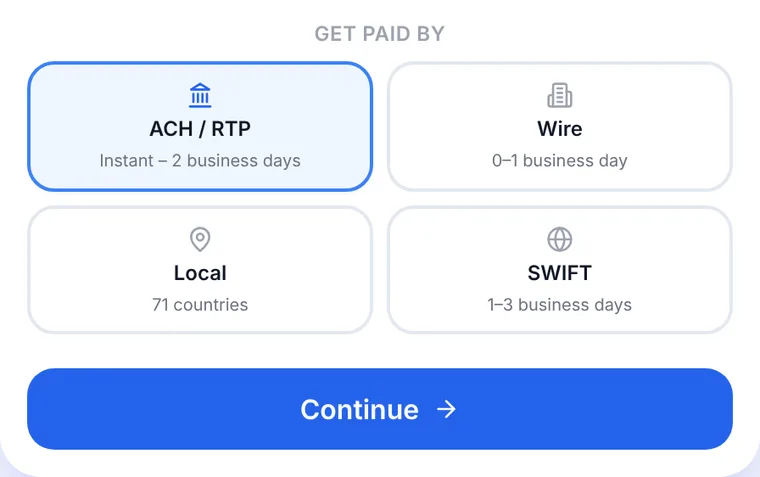
On Anytime Capital
FedNow, RTP, Fedwire and ACH in one business account
Pick the rail per payment instead of per bank: instant when it has to land now, a wire when the counterparty insists, ACH when it can wait, and local rails or stablecoins when it crosses a border. Sign up online in minutes.
- RTP & FedNowSeconds, any day
- WireSame day
- ACH to vendorsSame day or next day
- 71+ countriesMinutes to same day
- USDC & USDTMinutes, including weekends
Business account
Send and receive on every US rail
US account and routing numbers in your business's own name. Get paid by FedNow, RTP, wire or ACH, and pay the same ways, with every movement in one ledger.
Enterprise treasury
Operating accounts, approvals, API
Operating accounts and sub-accounts, approval rules and an audit trail, plus an API and signed webhooks for moving money from your own systems.
Personal
A cash account with a debit card
A cash account and card with early direct deposit and crypto built in, opened online in minutes, with no minimum balance.
Frequently Asked Questions
What does RTP stand for in banking?
Real-Time Payments: The Clearing House's instant payment network, launched in 2017. People also use 'real-time payments' generically for any instant payment, including FedNow.
How long does an RTP payment take?
Seconds. The receiving bank confirms the payment immediately and the money is available to the recipient right away, at any hour, any day.
What is the RTP limit?
$10 million per payment at the network level since February 9, 2025. Banks set their own limits within that, and consumer limits are usually much lower.
Can an RTP payment be reversed?
No. RTP payments are final. The sending bank can ask the receiving bank to return a mistaken payment, but the recipient has to agree.
Is RTP the same as Zelle?
No. RTP is an interbank network for any payment between bank accounts, including large business payments. Zelle is a bank-owned person-to-person service with its own enrollment, rules and much lower limits.
Does RTP work with every bank?
No. Both banks must participate in RTP. Most large banks do; many smaller banks and credit unions are on FedNow instead or as well.
What happens if I send an RTP payment to the wrong account?
Contact your bank straight away. It can send a request for return of funds through the RTP network, but the payment is final and the recipient's bank needs its customer's agreement to send it back. If the account number simply doesn't exist, the payment is refused in seconds and never leaves your account.
Is RTP more expensive than ACH?
The network cost to banks is a few cents per payment, close to ACH. What customers pay depends on their bank; many offer instant payments free or for a small fee.
Is an RTP payment the same as a wire?
Both are final, but a wire runs on business days with cutoffs, while RTP settles in seconds at any hour. Wires remain the norm for international payments and for counterparties that require them.
Keep reading
Important Disclosures
- Network limits, hours, volumes and dates cited on this page come from each network operator's published rules and statistics as of the dates shown, and may have changed. Banks and payment providers set their own limits and cutoffs within the network maximums.
- Payment network names (Fedwire, FedNow, RTP, ACH, SEPA, Faster Payments, PIX, SPEI, UPI, PayNow and others) belong to their operators and are used to identify the networks only; no affiliation or endorsement is implied.
- Information on this page is general and educational — it is not financial, legal, or tax advice.
- Anytime Capital is a fintech company, not a bank. Banking services are provided by our licensed banking partners. Stablecoins and other digital assets are not bank deposits, are not FDIC-insured and may lose value.