Answer
What is a UPI payment?
Quick answer
UPI (Unified Payments Interface) is India's real-time payment system, launched by the National Payments Corporation of India in April 2016. It moves rupees between bank accounts in seconds, 24/7, using a UPI ID such as name@bank, a QR code or a phone number, and each payment is authorised with a UPI PIN.
Updated October 2026. Evergreen page — refreshed in place as facts change.
- Launched
- Apr 2016
- April 11, 2016
- Operator
- NPCI
- Under Reserve Bank of India oversight
- Speed
- Seconds
- Authorised by the payer's UPI PIN
- Hours
- 24/7/365
- Weekends and holidays included
- Limit
- ₹1 lakh
- Typical; up to ₹5 lakh for some categories
- Identifier
- UPI ID
- Or account number + IFSC, or QR
- Volume
- 24.51B
- Transactions in August 2026, a record (NPCI)
- Who can use it
- Indian accounts
- Any bank account linked to a UPI app
UPI is how India pays, for tea, rent, taxes and invoices alike. The Unified Payments Interface, launched by the National Payments Corporation of India (NPCI) on April 11, 2016, processed a record 24.51 billion transactions in August 2026 and averaged more than 800 million a day in September (NPCI). A UPI payment moves rupees between bank accounts in seconds, at any hour, addressed by a UPI ID or a QR code and authorised with a PIN on the payer's phone. This page explains what a UPI payment is, how it moves, its limits and charges, what keeps it safe, and how a US business pays a contractor or supplier in India.
Payment methods on this page


.svg)
What is a UPI payment, and who runs UPI?
UPI is an interoperable layer that lets any participating app pay any participating bank account. NPCI, the not-for-profit payments organisation set up by India's banks under the Reserve Bank of India's oversight, runs the central switch; banks hold the accounts; and apps — banks' own and third-party ones — give customers the screen they pay from. Because every app talks to every bank through the same switch, a customer can link several bank accounts to one app, or one account to several apps, and pay anyone on any of them.
Underneath, UPI rides on India's IMPS instant-payment infrastructure: the payer's bank debits the account and the payee's bank credits it in real time, and the banks settle the net amounts between them later through the Reserve Bank of India, in several settlement cycles a day.
The scale is unlike any other instant rail: 24.07 billion transactions worth ₹29.37 lakh crore in September 2026, about 802 million a day, after August's record of 24.51 billion (NPCI). On an average day UPI now carries roughly 95 times as many payments as the US FedNow Service handled in all of 2025.
How does a UPI payment move?
The payer starts in an app, NPCI's switch finds the two banks, and the PIN proves the account holder approved it. Nothing is pulled from the payer without that PIN, which the payer's bank verifies and the app never sees.
A UPI payment, start to finish
- 1
Payer enters
A UPI ID, phone number or QR code, and the amount, in any UPI app.
Any hour - 2
Name shown
The app shows the name linked to the payee's UPI ID.
Before PIN - 3
Payer authorises
The UPI PIN, entered on the device bound to the account, approves the debit.
UPI PIN - 4
NPCI switches
The payer's bank debits; NPCI routes the credit to the payee's bank.
Seconds - 5
Both confirmed
Both sides get a 12-digit UTR; banks settle net later through the RBI.
UTR
How fast is UPI compared with India's other payment rails?
A UPI payment completes in seconds, 24 hours a day, every day. India's other bank rails also run around the clock now, but they work differently: IMPS is instant too and takes payments up to ₹5 lakh by account number and IFSC; NEFT, available 24x7 since December 2019, settles in 48 half-hourly batches; and RTGS, 24x7 since December 2020, settles large payments of ₹2 lakh or more individually in real time.
From the US, the slow part is never the Indian rail. An international wire to India takes one to three business days because of the correspondent chain and the receiving bank's handling of a foreign inward remittance, which has to be classified before it is credited. A payout converted to rupees and sent domestically skips most of that wait.
Typical time for rupees to arrive
- UPISeconds
- IMPSSeconds
- RTGSMinutes
- NEFTNext half-hourly batch
- SWIFT wire to India1–3 business days
What are UPI's limits and charges in 2026?
NPCI's standard limit is ₹1 lakh (₹100,000) per transaction, with higher limits — up to ₹5 lakh — for categories such as tax payments, hospitals, education and IPO or capital-market payments. Banks set their own caps within that, including a daily amount and a maximum number of transactions a day, and new users often start on lower limits.
For people, UPI is free: there is no charge to send or receive between individuals. Merchant payments have carried a zero merchant discount rate (MDR) as government policy since 2020. In September 2026 the government announced a 0.4% MDR on specified person-to-merchant payments above ₹2,000, capped at ₹300 a transaction, with small merchants exempt — originally from October 15, 2026, though later reports say the start was deferred, so check NPCI's current notification. Either way the merchant pays, not the customer, and person-to-person transfers stay free.
| What | Rule | Source |
|---|---|---|
| Standard limit | ₹1 lakh per transaction | NPCI |
| Higher-limit categories | Up to ₹5 lakh for tax, hospitals, education, IPOs and some others | NPCI |
| Bank limits | Daily amount and count caps, set by each bank | Each bank |
| Person-to-person | Free | Government policy |
| Merchant payments up to ₹2,000 | No MDR | Government policy |
| Specified merchant payments above ₹2,000 | 0.4% MDR, capped at ₹300, announced for October 15, 2026; start reported deferred; small merchants exempt | Government framework, September 2026 |
| Person-to-person collect requests | Discontinued from October 1, 2025 | NPCI |
What details do you need to pay someone by UPI?
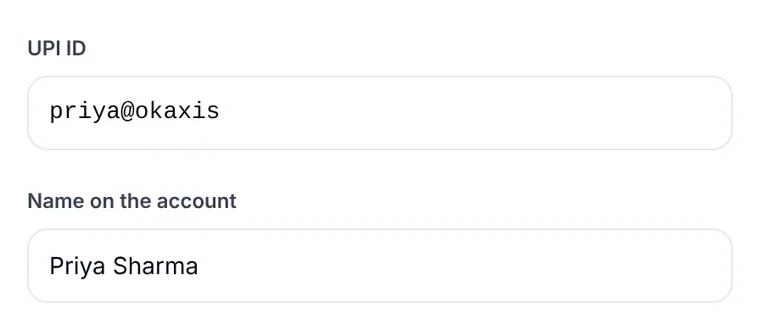
Usually just a UPI ID — a virtual payment address in the form name@handle, where the handle identifies the app or bank that issued it (priya@okaxis, for example). It stands in for the account number and IFSC behind it, and one account can have several IDs. A QR code carries the same ID, and many apps also accept the mobile number linked to an account.
Without a UPI ID, an Indian account is paid by account number and IFSC, the 11-character branch code: four letters for the bank, a zero, and six characters for the branch. That route goes over IMPS, NEFT or RTGS rather than UPI. Either way the name matters: inward payments from abroad are checked against the account holder's name, so use it exactly as the bank holds it.
How safe is UPI, and what protects payers?
UPI's security rests on the device and the PIN. An account can only be linked to a UPI app on a phone holding the SIM registered with the bank, and every payment needs the UPI PIN, which the bank verifies. Before the PIN screen, the app shows the payee's name, which is the moment to catch a wrong ID.
Most UPI fraud is persuasion rather than hacking: someone talks the victim into approving a payment. NPCI closed the most abused route on October 1, 2025, when it stopped person-to-person collect requests, so a stranger can no longer send a request that a hurried user approves by mistake. Merchants can still send payment requests, and the rules worth remembering are short:
- You never enter a UPI PIN to receive money — only to pay.
- Check the name on the confirmation screen against the person or business you meant to pay.
- Report a fraudulent payment to your bank and in the app at once; a completed UPI payment is not automatically reversible.
- Businesses: share one verified UPI ID or QR code, and confirm payments in your own account rather than from a customer's screenshot.
UPI vs SWIFT, IMPS, NEFT and FedNow
UPI and FedNow solve the same problem — instant, final, any-hour transfers between banks — but UPI added a consumer layer the US rails do not have: one address that works from any app to any bank, with PIN approval on the phone. IMPS, UPI's older sibling, does the same job by account number and IFSC. SWIFT is how money reaches India from abroad by default, and it is the slow leg of the journey.
| Rail | Speed | Hours | Addressed by | Typical limit |
|---|---|---|---|---|
| UPI | Seconds | 24/7/365 | UPI ID, QR code or phone number | ₹1 lakh (higher for some categories) |
| IMPS | Seconds | 24/7/365 | Account + IFSC, or mobile number | ₹5 lakh |
| NEFT | Half-hourly batches | 24/7/365 | Account + IFSC | No upper limit |
| RTGS | Real time | 24/7/365 | Account + IFSC | Minimum ₹2 lakh |
| SWIFT wire to India | 1–3 business days | Bank business days | Account + IFSC + SWIFT code | Bank limits |
| FedNow (US) | Seconds | 24/7/365 | Routing + account number | $10 million |
How does a US business pay a contractor or supplier in India?
A US bank can't send a UPI payment. The ordinary route is an international wire to the recipient's account number and IFSC, through their bank's SWIFT code; the Indian bank receives it as a foreign inward remittance, converts it to rupees at its own rate, and credits it once the payment's purpose has been classified under the Reserve Bank of India's purpose codes — software services, consulting and so on. Recipients often need the bank's inward remittance advice for their own records.
The quicker route is a provider that converts dollars to rupees and pays the recipient domestically, by UPI ID or by account and IFSC. Before you pay people in India regularly, sort out:
- Which details to collect: a UPI ID, or the account number and IFSC, plus the name exactly as the bank holds it.
- A one-line description of what each payment is for, in case the receiving bank asks.
- Tax paperwork on your side: US businesses generally collect Form W-8BEN from foreign individual contractors (W-8BEN-E from entities) instead of a W-9 — general information, not tax advice.
- The contract currency: pricing in rupees means exchange-rate moves don't leave the contractor short.
How does UPI work on Anytime Capital?
Anytime Capital business accounts pay contractors and suppliers in India in rupees, from the same balance as your US receipts. An Indian recipient can be added by UPI ID, or by account number and IFSC, in which case the payout travels over NEFT or RTGS instead of UPI; the add-recipient form offers both and checks each format. India is one of the 71 countries we pay out to over local rails, with SWIFT for everywhere else.
Before you send, the review gives the rupee amount the recipient gets, the rate, the fee shown separately and the total in dollars, and names the rail; for a UPI payout the expected arrival reads usually within minutes. A first payout to a new contractor may come with a question about what it is for — processing is subject to compliance review — and our processing times page explains how each payout method behaves.
On Anytime Capital
FedNow, RTP, Fedwire and ACH in one business account
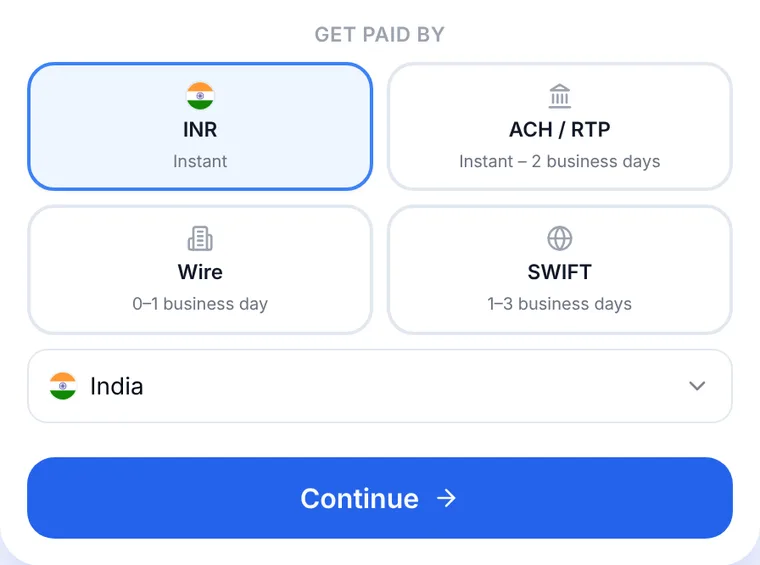
Pick the rail per payment instead of per bank: instant when it has to land now, a wire when the counterparty insists, ACH when it can wait, and local rails or stablecoins when it crosses a border. Sign up online in minutes.
- RTP & FedNowSeconds, any day
- WireSame day
- ACH to vendorsSame day or next day
- 71+ countriesMinutes to same day
- USDC & USDTMinutes, including weekends
Business account
Send and receive on every US rail
US account and routing numbers in your business's own name. Get paid by FedNow, RTP, wire or ACH, and pay the same ways, with every movement in one ledger.
Enterprise treasury
Operating accounts, approvals, API
Operating accounts and sub-accounts, approval rules and an audit trail, plus an API and signed webhooks for moving money from your own systems.
Personal
A cash account with a debit card
A cash account and card with early direct deposit and crypto built in, opened online in minutes, with no minimum balance.
Frequently Asked Questions
Can I use UPI from the US?
Only with an Indian bank account linked to a UPI app. Non-resident Indians can link NRE or NRO accounts at participating banks. A US business without an Indian account pays UPI recipients through a provider that converts dollars and pays the UPI ID inside India.
What is the UPI transaction limit?
₹1 lakh per transaction for most payments, and up to ₹5 lakh for categories such as tax, hospitals, education and IPOs (NPCI). Each bank also sets daily amount and count limits, which can be lower.
Is UPI free?
For individuals, yes: sending and receiving between people costs nothing. A 0.4% merchant charge, capped at ₹300, on specified merchant payments above ₹2,000 was announced in September 2026 for October 15, with small merchants exempt; reports say its start was deferred. Customers are not charged either way.
What is a UPI ID?
A virtual payment address such as name@okaxis that points to a bank account. The part after the @ identifies the app or bank that issued it. It lets someone pay you without knowing your account number or IFSC.
Can a UPI payment be reversed?
Not by the payer once it completes: UPI payments are final. A payment that fails midway is reversed automatically by the banks. For a payment sent to the wrong person or a fraudster, raise a complaint in the app and with your bank straight away.
What is the difference between UPI and IMPS?
Both are instant and run 24/7, and UPI is built on IMPS's infrastructure. IMPS is addressed by account number and IFSC, with a ₹5 lakh limit; UPI adds the UPI ID, QR codes and PIN approval in any app, with a ₹1 lakh standard limit.
Does UPI work outside India?
Partly. UPI has been linked with Singapore's PayNow for person-to-person transfers since February 2023, and Indian travellers can pay by UPI at some merchants in about ten countries, including the UAE, France, Bhutan, Nepal, Mauritius and Sri Lanka (2026). At least one side still uses an Indian account.
Keep reading
Important Disclosures
- Network limits, hours, volumes and dates cited on this page come from each network operator's published rules and statistics as of the dates shown, and may have changed. Banks and payment providers set their own limits and cutoffs within the network maximums.
- Payment network names (Fedwire, FedNow, RTP, ACH, SEPA, Faster Payments, PIX, SPEI, UPI, PayNow and others) belong to their operators and are used to identify the networks only; no affiliation or endorsement is implied.
- Information on this page is general and educational — it is not financial, legal, or tax advice.
- Anytime Capital is a fintech company, not a bank. Banking services are provided by our licensed banking partners. Stablecoins and other digital assets are not bank deposits, are not FDIC-insured and may lose value.