Answer
What is SEPA Instant?
Quick answer
SEPA Instant (SCT Inst) is the euro payment scheme that moves money between bank accounts across the 41-country SEPA area in 10 seconds or less, 24 hours a day, every day. Payments are addressed by IBAN, and since October 2025 euro-area banks must send them for no more than a standard transfer.
Updated October 2026. Evergreen page — refreshed in place as facts change.
- Launched
- Nov 2017
- November 21, 2017, European Payments Council
- Cleared by
- TIPS, RT1
- Eurosystem and EBA Clearing, plus national systems
- Speed
- ≤10 seconds
- Scheme maximum, payer's bank to payee's
- Hours
- 24/7/365
- No cutoffs, weekends or holidays
- Limit
- No scheme cap
- €100,000 cap removed Oct 2025; banks set limits
- Identifier
- IBAN
- Plus the payee's name, checked by VoP
- Share of transfers
- 35.6%
- Of euro credit transfers, Q1 2026 (EPC)
- Reach
- 41 countries
- EU, EEA, UK, Switzerland and others
SEPA Instant is how euros move in seconds. Formally the SEPA Instant Credit Transfer scheme, or SCT Inst, it connects banks and payment institutions across the 41 countries of the Single Euro Payments Area — the 27 EU member states, Iceland, Liechtenstein and Norway, and 11 more including the UK, Switzerland and Serbia — so that a euro transfer between any two of them lands within 10 seconds, at any hour. Since the EU's Instant Payments Regulation took full effect in October 2025, it has also become the default rather than the premium option in the euro area: banks must offer it, price it no higher than an ordinary transfer and check the payee's name before every payment. This page explains how a SEPA Instant payment moves, what it allows and costs, how it protects payers, and how a US business can use it to pay European suppliers.
Payment methods on this page
 SEPA InstantEuro · ≤10 seconds
- SWIFT1–5 business days
- FedNowSeconds · 24/7
- RTPSeconds · 24/7
.svg) USDCMinutes · 24/7
What is SEPA Instant, and how is it different from a normal SEPA transfer?
SEPA Instant Credit Transfer is a payment scheme: a rulebook owned by the European Payments Council (EPC) that every adhering bank and payment institution follows. It went live on November 21, 2017, next to the standard SEPA Credit Transfer (SCT), which still exists. Both address accounts by IBAN and use the same ISO 20022 messages. The difference is the clock. A standard SEPA transfer is processed on TARGET business days and reaches the payee by the next business day at the latest; an instant one must be credited, or rejected, within 10 seconds, at any hour on any day.
The scheme itself moves no money. Clearing and settlement mechanisms do: the Eurosystem's TIPS, which has settled each payment individually in central bank money since November 2018, EBA Clearing's RT1, and a handful of national systems. Banks reach one another through one or more of them, which is why a payment from Lisbon to Helsinki behaves like a domestic one.
Two properties set it apart from most bank transfers. It is final: once the payee's bank confirms, the payer's bank cannot pull the money back, only send a recall request that the payee's side has to agree to. And since the EU Instant Payments Regulation, (EU) 2024/886, it is no longer a premium extra. Euro-area banks have had to receive instant payments since January 9, 2025 and to send them since October 9, 2025, for no more than they charge for a standard transfer. In the first quarter of 2026, 35.6% of all euro credit transfers went instant, up from 30.7% in the third quarter of 2025 (EPC).
How does a SEPA Instant payment move?
Everything happens inside one 10-second window that opens when the payer's bank timestamps the order. Just before it, the payer's bank checks the payee's name against the IBAN through Verification of Payee. Then it debits the payer, sends the payment through its clearing mechanism and waits for the payee's bank to accept it. If no confirmation arrives in time, the payment is rejected and the payer's funds are released straight back, rather than sitting in a queue overnight the way a standard transfer can.
A SEPA Instant payment, end to end
- 1
Payer enters
The payee's IBAN, their name and the amount, in online banking or an app.
Any hour - 2
Name is checked
Verification of Payee compares the name with the account holder's.
Before approving - 3
Bank sends
Debits the payer and sends an ISO 20022 pacs.008 message to TIPS or RT1.
pacs.008 - 4
Payee's bank accepts
Checks the account can be credited and confirms back through the clearing system.
Seconds - 5
Money is available
The payee is credited, the payer's bank is told, and the payment is final.
≤10 seconds
How fast is SEPA Instant, and does it work on weekends?
The scheme's maximum is 10 seconds from the payer's bank to the payee's bank, and most payments complete in a few seconds. Nothing pauses it: not weekends, not public holidays, not Christmas Day, not the middle of the night. That is the practical difference from a standard SEPA transfer, which waits for TARGET business days on both sides, and from an international wire, which also waits for every correspondent bank in its chain.
For a business paying from the US, time zones stop mattering. A supplier payment approved at 11 p.m. on a Friday in New York reaches Frankfurt at 5 a.m. on Saturday and is credited moments later, instead of on Monday. The constraint moves to the sending side: how quickly your own provider releases the payment, and whether it sends it as SEPA Instant or as a standard transfer.
When euro payments move, across a week
SEPA Instant
Euro, instant
SEPA transfer
Standard SCT
SWIFT wire
From the US
FedNow & RTP
US instant
What are the SEPA Instant limits and fees in 2026?
There is no longer a scheme-wide maximum. The SCT Inst rulebook capped each payment at €100,000 until October 2025, when that ceiling was removed. Banks set per-payment and daily limits by account type and channel instead, and the Instant Payments Regulation lets any customer ask for a personal instant-payment limit, per payment or per day, and change it whenever they like.
On price, the regulation's rule is blunt: in the euro area, an instant transfer may not cost more than the same bank charges for a standard SEPA credit transfer. Many banks charge individuals nothing for either; business tariffs vary. Euro accounts at banks in non-euro EU countries, such as Poland or Sweden, come under the same obligations in 2027.
| Rule | What applies | Source |
|---|---|---|
| Maximum per payment | No scheme maximum since October 2025 (was €100,000) | EPC SCT Inst rulebook |
| Bank limits | Per payment and per day, by account type and channel | Each bank's terms |
| Customer-set limit | Payers can ask for their own daily or per-payment cap and change it any time | Regulation (EU) 2024/886 |
| Price in the euro area | No more than the same bank's standard SEPA transfer | Regulation (EU) 2024/886 |
| Euro-area banks | Must receive since January 9, 2025 and send since October 9, 2025 | Regulation (EU) 2024/886 |
| Non-euro EU banks | Must receive from January 9, 2027 and send from July 9, 2027 | Regulation (EU) 2024/886 |
| Execution time | 10 seconds maximum, any day, any hour | EPC SCT Inst rulebook |
What details do you need to send a SEPA Instant payment?
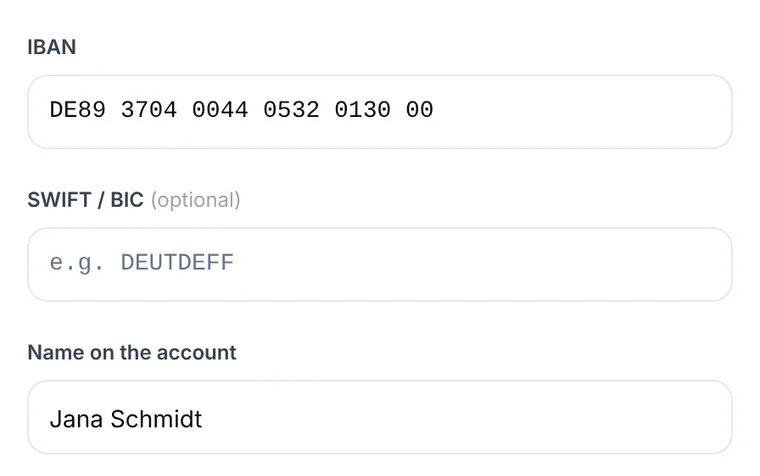
Two: the payee's IBAN and the name on their account. An IBAN starts with a two-letter country code and two check digits, followed by the national bank code and account number. A German IBAN has 22 characters, a French one 27 and a Dutch one 18; none is longer than 34. The check digits catch most typing errors before anything is sent. A BIC (SWIFT code) is optional for payments within SEPA, because banks can derive it from the IBAN.
The name matters as much as the number now. Verification of Payee compares it with the account holder's name before you approve, so use the payee's legal name exactly as it appears on their invoice or bank confirmation — for a company, its registered name rather than its trading brand. Put the invoice number in the remittance information, which carries up to 140 characters end to end.
To be paid by SEPA Instant, give payers your IBAN and account name and print both on invoices. One caveat for receivers outside the euro area: banks in the UK, Switzerland and other non-EU SEPA countries join the instant scheme by choice, so an IBAN there may only take standard SEPA transfers.
How does Verification of Payee protect a SEPA Instant payment?
Since October 9, 2025, every payment provider in the euro area must check, before the payer authorises a SEPA transfer — instant or standard — whether the name typed matches the name on the IBAN. The payee's bank returns one of four results: a match; a close match, where the payer is shown the actual account name; no match; or verification not possible. The payer can still go ahead on any result, but is warned that money sent to the wrong account may not come back. Businesses that submit payments as bulk files can opt out of the check for those batches.
The check exists because instant payments are final. Invoice-redirection fraud — a genuine-looking invoice with changed bank details — works on any rail, but a 10-second rail leaves no overnight window to catch it. The regulation adds two more safeguards: banks must screen their own customers against EU sanctions lists at least daily, so that sanctions checks need not hold up each payment, and customers can cap their own instant payments. What we would do on either side of a payment:
- Receiving: register your legal name exactly with your bank and print that same name on invoices, so payers' checks come back as a match.
- Paying: treat a close match as a prompt to compare the name shown, not as approval.
- Paying: treat a no match on a supplier you have paid before as a red flag, and call them on a number you already have before sending.
- Either side: if money goes to the wrong account, ask your bank for a recall at once; it can only come back with the payee bank's cooperation, and usually the payee's.
SEPA Instant vs SWIFT, FedNow and RTP
SEPA Instant is the euro area's counterpart to FedNow and RTP in the US: a 24/7 credit-push rail that settles in seconds and cannot be reversed by the payer. The differences are reach and adoption. SEPA Instant spans 41 countries and is mandatory for euro-area banks; FedNow, launched in 2023, had more than 1,800 participating institutions by July 2026 and carried about 8.4 million payments in 2025. SWIFT is a different kind of thing altogether: a messaging network between banks rather than a settlement rail, so an international wire is only as fast as the correspondent banks it passes through.
| Rail | Typical speed | Hours | Max per payment | Addressed by | Currency |
|---|---|---|---|---|---|
| SEPA Instant | ≤10 seconds | 24/7/365 | No scheme cap; bank limits | IBAN + name | EUR |
| SEPA Credit Transfer | By next business day | TARGET business days | No scheme cap; bank limits | IBAN + name | EUR |
| SWIFT wire | 1–5 business days | Bank business days | Bank limits | IBAN or account + BIC | Most currencies |
| FedNow | Seconds | 24/7/365 | $10 million (bank default $100,000) | Routing + account number | USD |
| RTP | Seconds | 24/7/365 | $10 million | Routing + account number | USD |
Typical time for euros to arrive
- SEPA Instant≤10 seconds
- FedNow / RTP (US)Seconds
- SEPA transferNext business day
- SWIFT wire from the US1–2 business days
How does a US business pay a European supplier by SEPA Instant?
Not directly from a US bank account. SEPA participants are banks and payment institutions inside the SEPA area, and a US bank is not one, so an ordinary US bank sends an international wire over SWIFT instead — in dollars, leaving the supplier's bank to convert at its own rate, or in euros converted by your bank before sending. Either way the payment can pass through correspondent banks, arrive short by intermediary fees and take one to two business days to the euro area. US banks commonly charge $35–$50 for an outgoing international wire (2026 industry range), before any exchange margin.
The faster route is a provider that holds euros inside SEPA: you pay in dollars, it converts and sends a SEPA Instant payment from a euro account, and the supplier sees a domestic euro credit for the full invoice amount. Before choosing one, check:
- Whether you see the exchange rate, and the exact euro amount the supplier receives, before you approve.
- Whether the payment goes out as SEPA Instant, or as a standard SEPA transfer when the supplier's bank can't take instant payments.
- What the supplier has to give you: the IBAN and legal name, and for a company usually its registration number and tax ID.
- Whether your invoice number travels in the remittance field, so the supplier can match the payment without asking.
- How first payments to a new supplier are reviewed, and how quickly a compliance question is raised and answered.
How does SEPA Instant work on Anytime Capital?
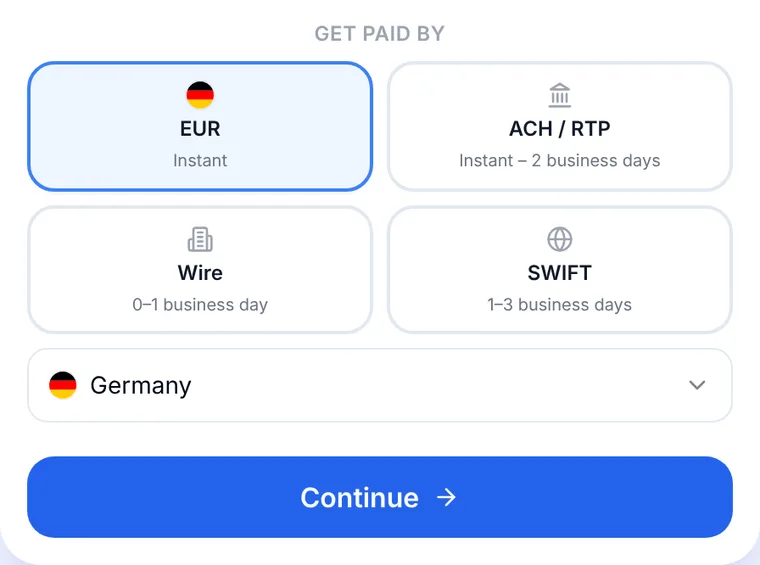
Anytime Capital business accounts pay suppliers in euros over SEPA Instant from the same balance that receives your ACH, wire, RTP and FedNow payments; the same account pays out over local rails in 71 countries, with SWIFT everywhere else. You add a recipient once — the country, then person or business, then the IBAN, with the BIC optional. A business recipient in the euro area is added with its legal name, registration number and tax ID.
Before you confirm, the review shows the exchange rate, the fee as its own line, the total taken from your balance, the euros the supplier receives, the rail, and the expected arrival: usually within seconds for SEPA Instant. If a payout is routed as a standard SEPA transfer instead, the review names that rail and shows same or next business day. The quoted price holds for a short countdown on screen. Fees are on our fees and limits page, and processing is subject to compliance review; a first payment to a new supplier can come with a question about what it is for, and a prompt answer keeps it moving.
On Anytime Capital
FedNow, RTP, Fedwire and ACH in one business account
Pick the rail per payment instead of per bank: instant when it has to land now, a wire when the counterparty insists, ACH when it can wait, and local rails or stablecoins when it crosses a border. Sign up online in minutes.
- RTP & FedNowSeconds, any day
- WireSame day
- ACH to vendorsSame day or next day
- 71+ countriesMinutes to same day
- USDC & USDTMinutes, including weekends
Business account
Send and receive on every US rail
US account and routing numbers in your business's own name. Get paid by FedNow, RTP, wire or ACH, and pay the same ways, with every movement in one ledger.
Enterprise treasury
Operating accounts, approvals, API
Operating accounts and sub-accounts, approval rules and an audit trail, plus an API and signed webhooks for moving money from your own systems.
Personal
A cash account with a debit card
A cash account and card with early direct deposit and crypto built in, opened online in minutes, with no minimum balance.
Frequently Asked Questions
Is SEPA Instant free?
In the euro area it cannot cost more than a standard SEPA transfer at the same bank, under Regulation (EU) 2024/886, and many banks charge individuals nothing for either. Business tariffs vary, and payments sent from outside the EU are priced by the sending bank or provider.
How long does a SEPA Instant transfer take?
10 seconds at most from the payer's bank to the payee's bank, at any hour on any day, and most arrive in a few seconds. If the payee's bank cannot confirm within that window, the payment is rejected and the payer's money is released.
Can a SEPA Instant payment be reversed?
No. It is final once the payee's bank confirms it. The payer's bank can send a recall request — for a duplicate, a technical error or fraud — but the money only comes back if the payee's bank, and usually the payee, agree. That is why Verification of Payee runs before you approve.
Is there a limit on SEPA Instant payments?
Not at the scheme level since October 2025, when the €100,000 maximum was removed. Each bank sets its own per-payment and daily limits, and customers can ask their bank to set a personal instant-payment limit and change it at any time.
Do all European banks offer SEPA Instant?
All euro-area banks must receive instant euro payments (since January 2025) and send them (since October 2025). Banks in non-euro EU countries follow in 2027. In non-EU SEPA countries such as the UK and Switzerland, joining the instant scheme is each bank's own choice.
What is the difference between SEPA and SEPA Instant?
Both move euros by IBAN across the same 41 countries. A standard SEPA credit transfer is processed on business days and arrives by the next business day; SEPA Instant arrives within 10 seconds, 24/7, and is final at once. In the euro area both now cost the same.
Can I receive SEPA Instant payments into a US bank account?
Not directly. A US bank account has no IBAN and its bank is not a SEPA participant, so a European payer would have to send an international wire. Receiving by SEPA Instant needs an account held at an institution inside SEPA.
Keep reading
Important Disclosures
- Network limits, hours, volumes and dates cited on this page come from each network operator's published rules and statistics as of the dates shown, and may have changed. Banks and payment providers set their own limits and cutoffs within the network maximums.
- Payment network names (Fedwire, FedNow, RTP, ACH, SEPA, Faster Payments, PIX, SPEI, UPI, PayNow and others) belong to their operators and are used to identify the networks only; no affiliation or endorsement is implied.
- Information on this page is general and educational — it is not financial, legal, or tax advice.
- Anytime Capital is a fintech company, not a bank. Banking services are provided by our licensed banking partners. Stablecoins and other digital assets are not bank deposits, are not FDIC-insured and may lose value.